What That Loud Bang Means When Your Garage Door Won't Open
You're inside the house, maybe watching TV or getting ready for work, when you hear a sudden, startling bang from the garage. It sounds like something fell off a shelf - or worse. You head out, press the opener button, and nothing happens. The garage door won't open, or the opener strains and barely moves it.
If this sounds like what just happened at your home, you're not alone. This is one of the most common calls we get from homeowners across Central Connecticut, and in most cases, the answer is the same: a garage door spring just broke.
Why a Broken Spring Causes That Loud Bang
Garage door springs are under tremendous tension. They carry the vast majority of your door's weight, which can be well over a hundred pounds for a standard residential door and significantly more for a double-wide. When a spring snaps, that stored energy releases instantly, producing a loud bang that echoes through the garage and often startles the entire household.
After the spring breaks, your door loses the counterbalance that makes it manageable to open. The opener was never designed to lift the full dead weight of the door on its own - it was engineered to work alongside functioning springs. That's why the door won't open after that loud noise, or why the motor runs but the door barely budges.
This is one of the clearest broken garage door spring symptoms: a sudden loud bang followed immediately by a door that will not open normally.
What You Can Safely Check
There are a couple of things you can look at without touching any springs, cables, or high-tension hardware.
Look at the Springs Visually
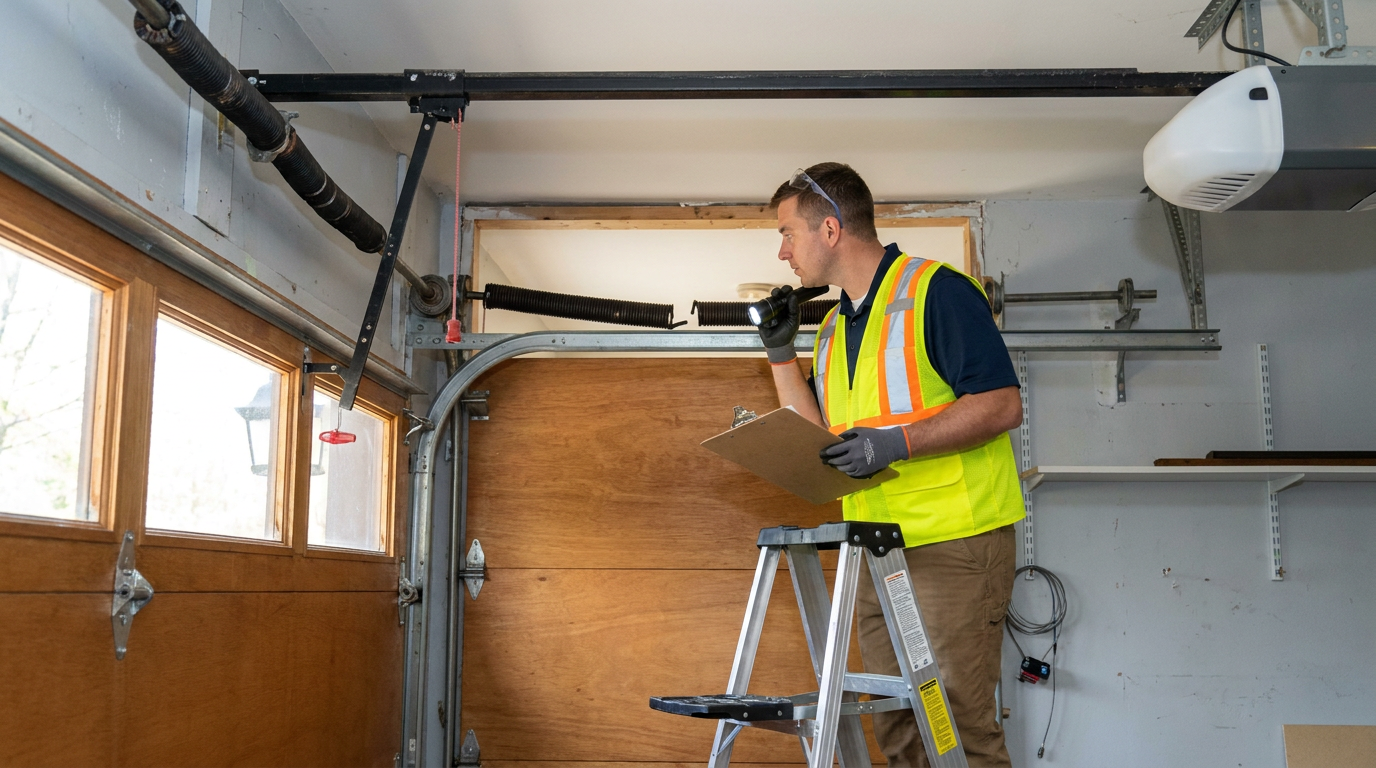
If you have torsion springs, they're mounted on a metal shaft above the door opening. If you have extension springs, they run along the horizontal tracks on either side of the door. In either case, look - don't touch - for a visible gap or separation in the spring coil. A broken torsion spring will typically have an obvious gap where the coil snapped apart.
Most of the time a broken spring is easy to spot, but occasionally the break can be in a position that makes it harder to see. If you don't notice a clear break, that doesn't necessarily mean the springs are fine.
Do Not Go Beyond a Visual Check
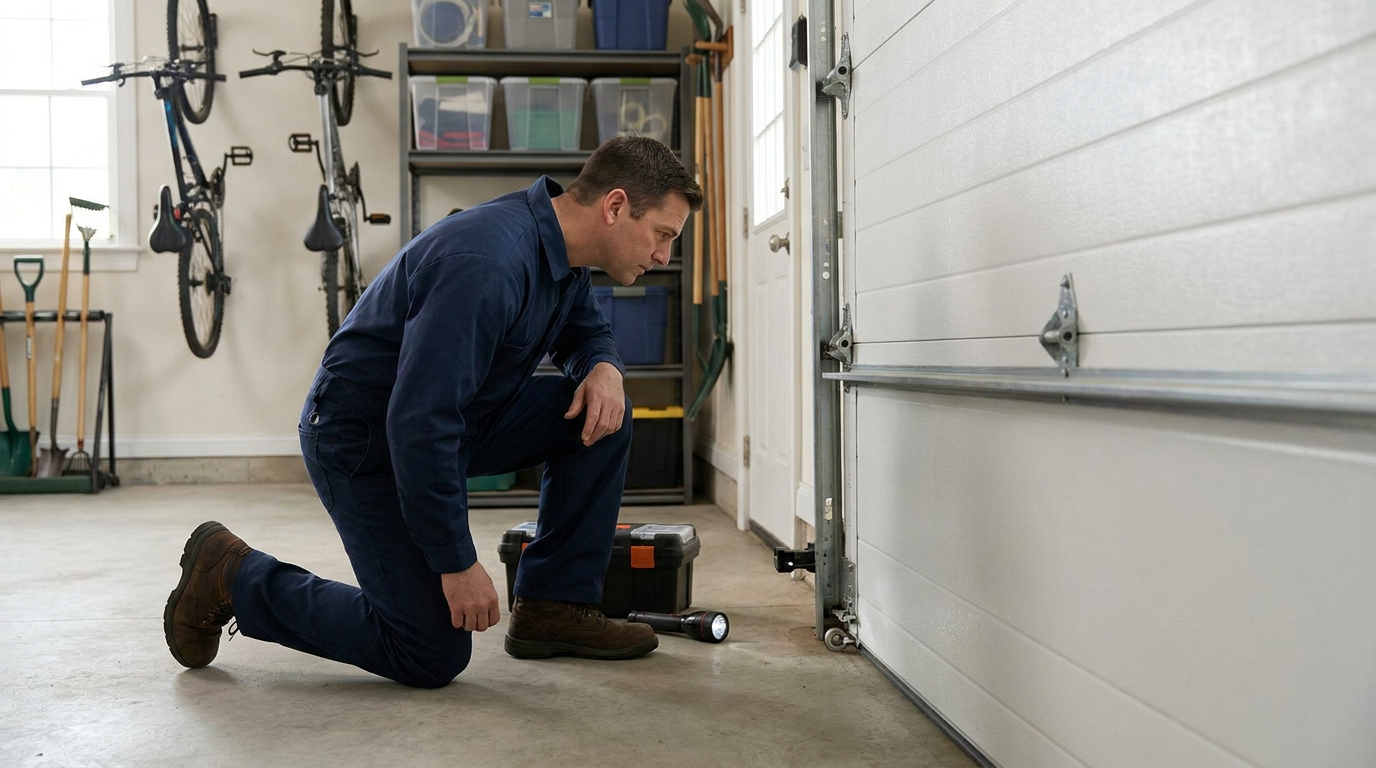
We want to be very clear: visual inspection from a safe distance is the only step homeowners should take. Do not touch, adjust, or attempt to remove any spring, cable, drum, or high-tension component. These parts store dangerous amounts of energy and require professional tools and training to handle.
What You Should Not Do After the Bang
This section is critical. When a garage door spring broke and caused a loud bang, there are two things homeowners commonly try that can make the situation worse - or dangerous.
Do Not Keep Running the Opener
It's tempting to press the button again, thinking the door might just be stuck. Resist that urge. When the opener tries to lift a door that has no spring assistance, it puts a tremendous amount of strain on the motor - far more than it was designed for. Repeated attempts can burn out the motor entirely, turning a spring repair into a spring repair plus an opener replacement. If the door will not open after the bang, leave the opener alone and schedule a diagnosis.
Do Not Try to Lift the Door Manually
Without functioning springs, the full weight of the door is unassisted. Garage doors are extremely heavy, and without spring tension, a door that you manage to lift partway can come crashing back down with no warning. This is a serious safety hazard. Do not attempt to manually lift or prop open the door.
If a vehicle is stuck inside the garage, let the technician know when you call. If there's a separate walk-through door into the garage, use that for access in the meantime.
When the Bang Might Be Something Else
A broken spring is the most common cause of a sudden loud bang from the garage, but it's not the only possibility. If you look at the springs and they appear intact, and the door still feels light and balanced when gently tested by a professional, then the noise may have come from somewhere else in the system.
Other hardware failures - such as issues with brackets, tracks, or other components - can sometimes produce a loud sound. If the spring is not broken and the door still moves properly by hand, the situation calls for a broader garage door repair diagnosis to pinpoint the source. In some cases, what seems like a single loud noise could be related to a cable that came off a drum or pulley, which is a separate issue with its own set of symptoms.
It's also worth noting that a door that opens only a few inches before stopping is a slightly different scenario. If that better describes what you're experiencing, you may want to read our post on why a garage door opens a few inches then stops.
Why Both Springs Should Be Replaced Together
When one spring breaks, Spring King always recommends replacing both springs at the same time. Here's why.
Springs are rated for a specific number of cycles, with one full open-and-close counting as a single cycle. Both springs on your door have been working side by side through the same number of cycles since they were installed. If one has reached the end of its lifespan and snapped, the other spring has the same amount of wear and is likely not far behind.
Replacing only the broken spring means the new spring and the old spring will have very different remaining lifespans and potentially different performance characteristics. You'd likely be facing another broken spring repair in the near future, along with the cost of a second service call.
Connecticut Season Changes and Spring Failures
Homeowners in Central Connecticut sometimes notice that springs seem to break at particular times of year. While a spring can fail at any point once it has enough wear, temperature swings during seasonal transitions can be a contributing factor.
The first stretch of very cold days after a long hot summer, or the first warm spell coming out of a Connecticut winter, are periods when metal components experience thermal stress. This doesn't mean your springs will definitely break during a season change, but it's a pattern worth being aware of - especially if your springs are older and have accumulated a high cycle count.
What Happens During a Professional Spring Replacement
Replacing the springs is the core of the job, but a thorough repair involves more than just swapping out the broken parts. After installing new springs, our technicians inspect the drums, cables, pulleys, and bearings. These components work closely with the springs, and if any of them are worn, we recommend replacing them at the same time to keep the door operating smoothly and to help protect the new springs.
Once all hardware is confirmed to be in good condition, every moving part on the door gets fully lubricated. All hardware is checked for tightness and proper placement.
The final step is recalibrating the opener. New springs change the force profile of the door, so the opener's open and close force settings need to be adjusted to match. This ensures the opener works in proper harmony with the new springs rather than fighting against them - which is essential for both performance and longevity. If your opener needs service beyond recalibration, our team can address that as well through our opener services.
Regular tune-up and maintenance visits that include lubrication, hardware inspection, and spring assessment can help you catch wear before it leads to a sudden failure.
What to Have Ready When You Call
A few details can help us prepare for your service visit and get your door back in operation as efficiently as possible:
- Spring type: Do you have torsion springs (mounted on a shaft above the door) or extension springs (along the horizontal tracks on each side)? If you're not sure, that's perfectly fine - just describe what you see.
- Door size: Is it a single-wide door (for one car) or a double-wide door (for two cars)?
- Vehicle access: Is a car or other vehicle stuck inside the garage?
- Alternate entry: Is there another door into the garage besides the garage door itself, such as a walk-through door from the house or a side entry?
This information helps us arrive ready to work and gets your door back up and running faster.
Get Your Garage Door Working Again
If you heard a loud bang and your garage door won't open, the most important thing is to stop using the opener, stay away from the springs and hardware, and call a professional. For homeowners in Middletown, Middlesex County, Hartford County, New Haven County, and throughout Central Connecticut, Spring King Garage Doors is ready to help.
Contact us to schedule your repair. We'll diagnose the problem, handle the fix safely, and make sure your entire door system is working the way it should.
Need garage door help in Connecticut?
Spring King serves Middletown and 30+ towns across Central CT. Fast response available.
Add Spring King as a Preferred Source on Google