Garage Door Noises Explained: Grinding, Squeaking, Rattling & Banging
Every homeowner in Central Connecticut has heard it at some point: that unexpected noise coming from the garage door that makes you pause and wonder if something is about to go very wrong. Whether you live in Hartford County, New Haven County, or Middlesex County, your garage door faces the same seasonal swings and wear-and-tear that eventually produce sounds you should not ignore.
This guide breaks down the four most common garage door noises, tells you exactly what each one means, and helps you decide whether you can handle it yourself or need to call in a professional right away.
Why garage doors make noise
A residential garage door is a system of moving parts working together: springs, cables, pulleys, rollers, hinges, tracks, and an opener. Over time, these parts wear out, loosen, or lose lubrication.
When metal meets metal without proper maintenance, you get noise. Some noises are harmless early warnings. Others signal a dangerous failure that is already in progress.
The key is learning to tell the difference. That is exactly what we are going to do below.
Grinding
Causes
Grinding usually points to metal components dragging against each other in a way they were never designed to. The most common culprits include:
- A cable that has slipped off the drum or pulley and is rubbing against nearby hardware.
- Worn-out rollers, especially older steel rollers that have lost their bearings.
- A track that has shifted or bent, forcing the rollers to scrape along an uneven surface.
- Rust buildup on tracks or hardware after a long, wet Central CT winter.
What it sounds like
Grinding is a harsh, continuous, metallic scraping. It often gets louder as the door moves through a specific section of the track. You may also feel vibration through the wall if you place your hand near the track.
When to stop using the door and call
Pronounced grinding requires immediate attention. If the grinding is loud, getting worse, or accompanied by the door moving unevenly, stop using the door right away and call a professional.
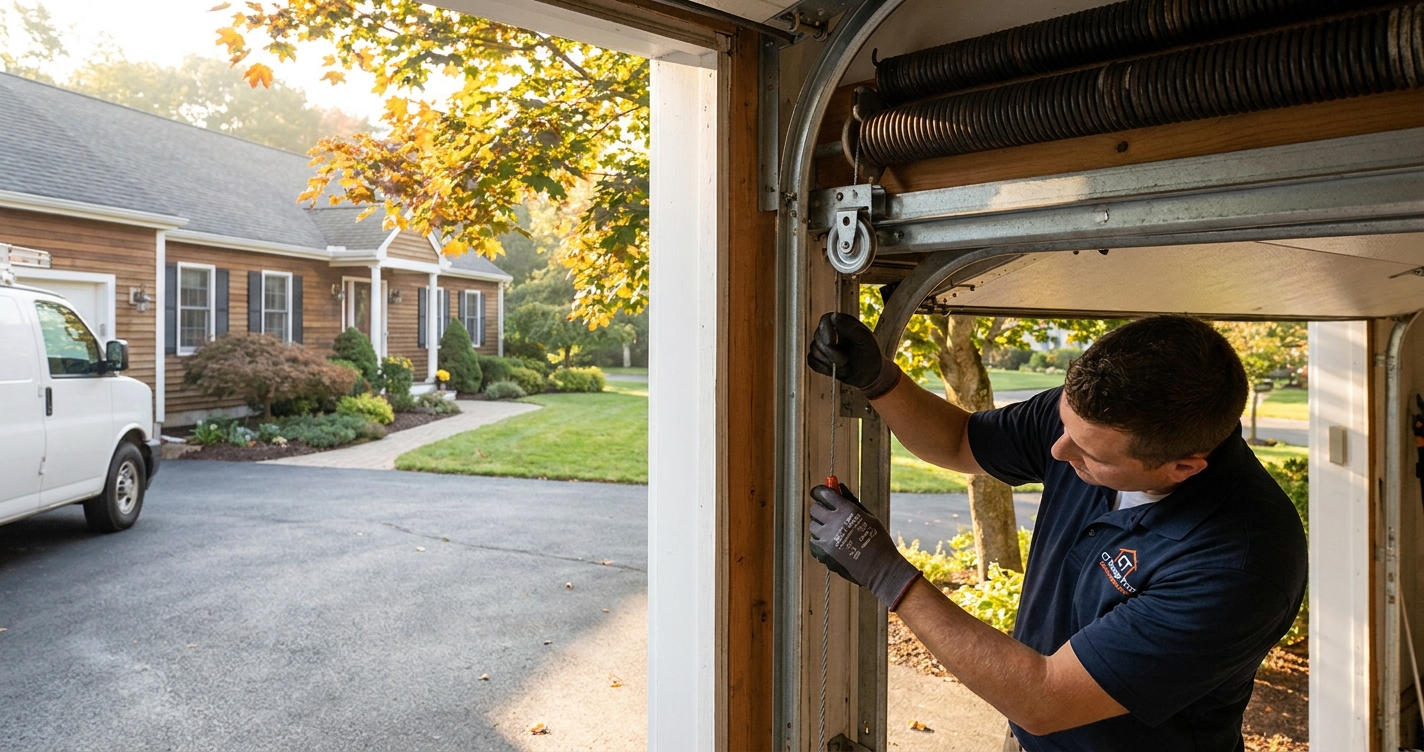
Here is why we take this so seriously. On a recent service call at a home here in Central CT, our team found an extension spring cable that had jumped its pulley groove and was rubbing directly against the edge of the pulley wheel. The outer strands of the cable were already frayed and visibly thinning. Had the homeowner continued to use the door, that cable would have snapped under tension, and the door, weighing well over 100 pounds, would have come crashing down with no controlled resistance. A frayed cable under spring tension is one of the most dangerous situations we encounter in the field.
If your grinding noise is pronounced or worsening, treat it as urgent.
What to try now
If the grinding is faint and just beginning:
- Visually inspect the tracks for debris, rust, or obvious bends. Remove any debris you can see.
- Look at the cables on both sides of the door. If you see any fraying, stop using the door immediately.
- Check the rollers. If they look worn, cracked, or are missing their ball bearings, note their condition for your technician.
- Apply a garage-door-specific lubricant (silicone or lithium-based spray) to the rollers and hinges. Never use WD-40 as a long-term lubricant because it is primarily a solvent and will dry out quickly.
Important: Never touch the springs or cables yourself. These components are under extreme tension.
What a pro will check
A trained technician will:
- Inspect every cable for fraying, kinks, or improper routing around drums and pulleys.
- Check pulley condition and alignment on extension spring systems.
- Evaluate roller condition and replace worn rollers. Our garage door roller replacement guide explains why ticking often points to failed bearings and why nylon rollers can make the door quieter.
- Verify track alignment and spacing.
- Test spring balance to ensure even weight distribution.
Cable and pulley repair is one of the most common fixes for grinding noises, and catching it early can prevent a much more expensive and dangerous failure.
Squeaking
Causes
Squeaking is the most common garage door noise, and it is usually the least dangerous. Typical causes include:
- Dry hinges and rollers that need lubrication.
- Nylon rollers that have aged and are no longer gliding smoothly.
- Weatherstripping rubbing against the door or frame.
- Torsion spring coils rubbing together as the spring winds and unwinds.
What it sounds like
Squeaking is a high-pitched, repetitive sound that occurs in rhythm with the door's movement. It may be loudest at certain points in the travel path, particularly near the top or bottom of the cycle.
When to schedule a tune-up
Squeaking, on its own, can usually wait until your next scheduled tune-up, as long as the door is otherwise moving smoothly, staying level, and opening and closing without struggle. Think of it as your garage door politely asking for some attention.
However, if the squeaking is accompanied by jerky movement, the door going off-track, or difficulty opening and closing, escalate the call. That combination points to a bigger issue.
What to try now
- Lubricate all metal hinges and rollers with a silicone-based garage door lubricant.
- Spray the torsion spring lightly to quiet coil-on-coil friction.
- Check the weatherstripping along the top and sides of the door. If it is cracked, warped, or pressing too hard against the panels, consider replacing it.
- Tighten any visibly loose hinge bolts with a socket wrench. A loose hinge can squeak as it shifts under load.
What a pro will check
During a tune-up, a technician will:
- Lubricate all moving parts with professional-grade products.
- Inspect rollers and recommend replacements if they are worn or cracked.
- Check hinge condition and bolt tightness across all panels.
- Evaluate spring condition and balance.
- Test the opener's force settings to ensure nothing is being strained.
Regular maintenance goes a long way. Many homeowners in Hartford and New Haven counties schedule an annual tune-up, and that single visit often eliminates squeaking for the entire year.
Rattling
Causes
Rattling is almost always a loose-hardware issue. The usual suspects are:
- Loose nuts and bolts on the track brackets, hinges, or roller brackets.
- A loose chain or belt on the garage door opener.
- Worn opener brackets or mounting hardware where the opener attaches to the ceiling or header wall.
- Loose screws on the door panels themselves.
What it sounds like
Rattling is a fast, shaky, metallic vibration. It often sounds like something is buzzing or trembling inside the door or near the opener. You may notice it is loudest right when the door starts or stops moving.
When to schedule a tune-up
Like squeaking, basic rattling can wait until your next tune-up if the door is functioning normally. A little rattle after several years is expected, especially in Central CT homes where temperature swings cause hardware to expand and contract seasonally.
If the rattling is sudden, dramatic, or paired with visible movement in the tracks or brackets, do not wait. Call sooner.
What to try now
- Grab a socket set and carefully tighten any bolts you can reach on the tracks, track brackets, and hinges. Do not over-tighten, just snug.
- Check the opener rail and mounting bracket. If you see the bracket wobbling at the ceiling, the lag bolts may need attention.
- Inspect the chain or belt on your opener. A sagging chain will slap and rattle during operation. Consult your opener manual for the proper tension adjustment.
- Look for any loose screws on the door panels. Panel screws can vibrate loose over time.
What a pro will check
A technician will go through every fastener in the system. They will also:
- Inspect the track for proper anchoring to the wall and ceiling.
- Evaluate the opener mounting and reinforce it if needed.
- Check the door balance. An unbalanced door puts uneven stress on hardware, causing things to loosen faster.
- Look for cracked or fatigued brackets that need replacement rather than just re-tightening.
Garage door repair covers these types of hardware issues and more.
Banging
Causes
Banging is the noise that should get your full attention immediately. It often indicates:
- A broken or breaking torsion spring.
- A mounting plate or end bearing plate pulling away from the wall.
- A door that has jumped the track and is slamming against the frame.
- A severely unbalanced door dropping hard at the end of its travel.
What it sounds like
Banging is a loud, sharp, sudden impact sound. It may happen once during a cycle, or it may repeat. Sometimes it sounds like a heavy object being dropped or like someone struck the door with a hammer. If you hear a single explosive bang while the door is closed, a spring may have snapped.
When to stop using the door and call
Banging requires immediate attention. Stop using the door and call for help right away.
This is not an exaggeration. Here is a real example from our work. During a service call in Central Connecticut, our team arrived to find a torsion spring mounting plate that had pulled one of its lag bolts completely out of the wall header. The plate was barely hanging on by a single remaining bolt, tilted at an angle, and visibly stressed. The entire weight-bearing system of the door was on the verge of tearing free from the wall.
If that plate had fully detached, the wound torsion spring would have released its stored energy violently, and the door would have lost all counterbalance support instantly. We are talking about a situation that could cause catastrophic injury to anyone standing nearby.
The homeowner told us they had been hearing a banging sound for about a week but assumed it was the opener acting up. That banging was the bolt working its way out of the wall, one cycle at a time.
If you hear banging, do not open or close the door again. Call a professional.
What to try now
Honestly, the best thing to try right now is to stop using the door. Here is what you can safely do:
- Visually inspect the springs from a safe distance. If you see a gap in a torsion spring coil, the spring is broken.
- Look at the mounting plates and brackets at the top of the door opening. Are any of them tilted, loose, or visibly separated from the wall?
- Check whether the door is sitting level. If one side is higher than the other, something has failed.
- Disengage the opener by pulling the emergency release cord (the red handle) so no one accidentally activates the door with a remote.
Do not attempt any repairs on springs, mounting plates, or cables. These are high-tension components that require professional tools and training.
What a pro will check
For banging noises, a technician will perform a thorough safety inspection including:
- Full evaluation of all springs, checking for cracks, separation, or fatigue.
- Inspection of every mounting plate, end bearing plate, and bracket for secure attachment to the wall header.
- Verification that the header itself is structurally sound and can support the hardware.
- Cable inspection on both sides.
- Track alignment and roller condition.
- Opener force and limit adjustments.
Broken spring repair is time-sensitive work, and our team treats it as a priority call.
Quick checklist for homeowners
Here is a simple reference you can use the next time your garage door starts talking to you:
- Hear grinding? Check cables visually for fraying. If fraying is present or the sound is loud, stop using the door and call.
- Hear squeaking? Lubricate hinges, rollers, and springs with silicone spray. Schedule a tune-up at your convenience.
- Hear rattling? Tighten accessible bolts on tracks, hinges, and brackets. Schedule a tune-up if the door works normally.
- Hear banging? Stop using the door immediately. Pull the emergency release. Call a professional right away.
- Door moving crooked or struggling to open/close with any noise? Stop using the door and call. This combination always warrants urgent attention.
- Not sure what the sound is? When in doubt, disconnect the opener and call. It is always better to be cautious with a system that weighs hundreds of pounds and operates under high tension.
When to call Spring King Garage Doors
Some garage door noises are simple maintenance items. Others are urgent warnings that something dangerous is happening right now.
Here is a clear breakdown:
Immediate attention (stop using the door and call right away):
- Banging of any kind
- Pronounced or worsening grinding
- Any noise paired with the door moving crooked or off-track
- Any noise paired with the door struggling to open or close
- A single loud bang when no one was operating the door (likely a broken spring)
Can wait until your next tune-up:
- Squeaking, if the door moves smoothly and stays level
- Light rattling, if the door functions normally
Spring King Garage Doors serves homeowners across Hartford County, New Haven County, and Middlesex County. Whether you need an emergency spring replacement or a routine tune-up to quiet things down, our experienced team is ready to help.
Visit our garage door repair page to learn more about our services or to schedule a visit.
Your garage door is the largest moving part of your home. When it talks to you, listen. A few minutes of attention today can prevent a costly repair or a dangerous failure tomorrow. Stay safe out there, Central CT.
Need garage door help in Connecticut?
Spring King serves Middletown and 30+ towns across Central CT. Fast response available.
Add Spring King as a Preferred Source on Google